

Industrial retrofitting – The main points at a glance
- Definition: Targeted modernization and digital upgrades of existing machinery and plants in industrial and mechanical-engineering contexts
- Objective: Extend the service life of machinery, increase plant efficiency and integrate Industry 4.0 standards without purchasing expensive new equipment
- Typical measures: Upgrade control systems and safety technology, as well as retrofit intelligent vision cameras, optical sensors, and digital interfaces (e.g., IO-Link)
- Greatest benefit: Existing machinery infrastructure can still be used. This allows for a significant reduction in investment costs and downtime compared to purchasing a completely new system.
What does retrofitting mean for machines and plants?
Many production facilities contain equipment and machinery that continues to operate reliably even after many years. Their fundamental mechanical integrity is intact, although individual components no longer reflect current engineering practice. Control systems are outdated, spare parts are scarce, quality inspections are still performed by hand or the system does not provide the process data required for modern production operations.
This is where retrofitting comes in. In the industrial and mechanical engineering sectors, retrofitting refers to the targeted modernization of existing machines, systems, and production lines. Instead of replacing entire systems at great cost, specific, modern key components are retrofitted. The objective: To upgrade the existing system to the technological standard of Industrie 4.0, without having to invest in completely new machinery.
Typical measures involved in retrofitting
Depending on the condition of the existing system and the objectives set for it, retrofitting can involve different areas:
- Control-system, drive and safety technology: Outdated control systems, drives or safety components are replaced and adapted to meet current requirements.
- Sensor technology and machine vision: Optical sensors, vision sensors and cameras are used, for example, to perform presence, position, or quality checks.
- Communication interfaces: Modern interfaces, such as IO-Link or industrial Ethernet, enable the transmission of process and diagnostic data.
- Software and process data acquisition: Control software, testing programs and data acquisition systems are updated or enhanced to include new features.
- Mechanical and energy optimization: Individual assemblies, illumination systems or other components can be adapted to improve efficiency and operability.
Good to know: Not every retrofit entails extensive conversion work. Frequently, targeted retrofitting is sufficient to eliminate a specific weakness in the system.
Differences compared to repairs, maintenance or new acquisition
Sometimes, retrofitting, maintenance and repairs are used as synonyms in everyday routine operations. The measures involved, however, pursue different objectives.
| Measures | Main objective | Typical scope |
|---|---|---|
| Maintenance (preventive maintenance) | Prevent wear and failures | Regular oil changes, filter replacements, visual inspections |
| Repairs (corrective maintenance) | Restoring functionality after a defect | Replacement of defective mechanical or electrical parts with identical components |
| Retrofitting (modernization) | Enhancement of functions & digitalization | Updating sensor technology, (e.g. optical/vision), IO-Link, new control systems |
| New acquisition | Replacement of the entire system | Complete replacement with installation of new infrastructure |
When does retrofitting pay off?
Whether a retrofit makes economic and technical sense depends on the condition of the machine, the desired improvements and the planned future service life.
Of greatest importance is the question of whether the fundamental mechanical components still operate reliably. If so, targeted modernization or a machinery retrofit may be more attractive than procuring completely new equipment.
Typical signs that modernization is needed
A retrofit should be evaluated when the technology is outdated, failures are on the rise or the system is no longer able to meet the current production requirements. Typical indicators are:
- Spare parts are hard to find or components are technologically outdated
- Downtimes, rejections and rework are becoming more frequent
- Quality controls are still performed by hand or defects are detected too late
- Process data are unavailable or cannot be meaningfully evaluated
- Product changes and new variants entail high expenditures of time and effort
- The degree of automation, flexibility or system performance are no longer adequate
Decision-making tool: Retrofitting or a new machine?
The following matrix is designed to help you systematically evaluate your circumstances:
| Criterion | Suggests retrofitting | Suggests new acquisition |
|---|---|---|
| Mechanical condition | Base machine continues to be reliable and stable | Mechanical condition is heavily worn or damaged |
| Scope of functions | Certain functions or sensors are missing | The fundamental machine concept is no longer suitable |
| Performance & cycle times | Existing capacity is generally adequate | Significantly greater capacities/speeds are required |
| Integration & hall layout | Machine is already optimally integrated in the line | Production process needs to be completely redesigned |
| Degree of automation | Specific functions can be added in a targeted, modular manner | Design offers no options for expansion whatsoever |
| Time & downtimes | Conversion can be performed in the context of planned downtimes | Longer delivery, installation and start-up times are acceptable |
| Spare parts supply | Certain components are no longer available | Supplies for significant portions of the overall system are no longer available |
| Remaining useful life | The machine is expected to continue producing profitably for several more years | The machine is definitively at the end of its lifecycle |
The key benefits of retrofits in the industrial context
A retrofit preserves the proven machinery and modernizes it specifically where technical or economic improvements are needed. This results in a number of benefits:
- Prolong service life: A mechanically intact machine can continue to be used economically for many years by employing modern electronics, sensor technology and software.
- Make targeted investments: Instead of replacing the entire system, the budget is allocated to the components and functions that actually need to be modernized.
- Improve availability and supply of spare parts: Replacing discontinued or failure-prone components reduces the risk of failures and simplifies maintenance.
- Increase degree of automation Retrofitted sensors and vision systems can automate manual tasks such as presence, position, counting, or code checks.
- Safeguard quality and reduce rejections: Defects are detected directly in the process. This allows defective parts to be removed from production early on and reduces rework, material consumption and follow-up costs.
- Improve flexibility and data utilization: Modern components can be adapted more easily to new product variants and provide additional process and quality data for analysis and optimization.
Retrofit with maximum impact: Optical sensors & vision sensors
Not every retrofit requires months of work to overhaul the entire machine control system. Often, a targeted, minimally invasive intervention is all it takes to improve system efficiency, for instance, retrofitting intelligent optical sensors and camera-based vision systems.
They serve as the old machine’s modern "senses." The advantage: Depending on the existing control system and interface, optical sensors and vision systems can be integrated in existing processes with comparatively little effort.

1. Optical sensors: Precision in the smallest of spaces
Classic optoelectronic sensors are the easiest way to get started with sensor retrofitting. They are used for tasks such as:
- Precision object & distance measurement: Checks heights, stack levels, or distances (e.g., whether a component is properly positioned or whether the material flow is blocked).
- Color detection & contrast checking: Measures color and reflection and, based on these, detects whether the correct product variant is in position, markings are present or protective caps are missing.
- Easy integration via IO-Link: Data are transmitted digitally which minimizes the need for cabling and enables diagnostic functions directly on the PC.
2. Vision sensors for automated quality inspections
When simple optical sensors reach their limits, vision sensors come into play. They combine the performance of modern image processing with the easy handling of a standard sensor and carry out tasks such as:
- Automated quality & completeness inspections: Inline testing of components for presence, cracks, dimensions or completeness in fractions of a second.
- Reading codes & text Complete traceability through the scanning of 1D/2D codes directly on the machine.
- Robot guidance & Target Mark 3D: Automatic referencing and position detection for retrofitted or mobile robots – ideal for integrating new processes and requirements into existing systems.
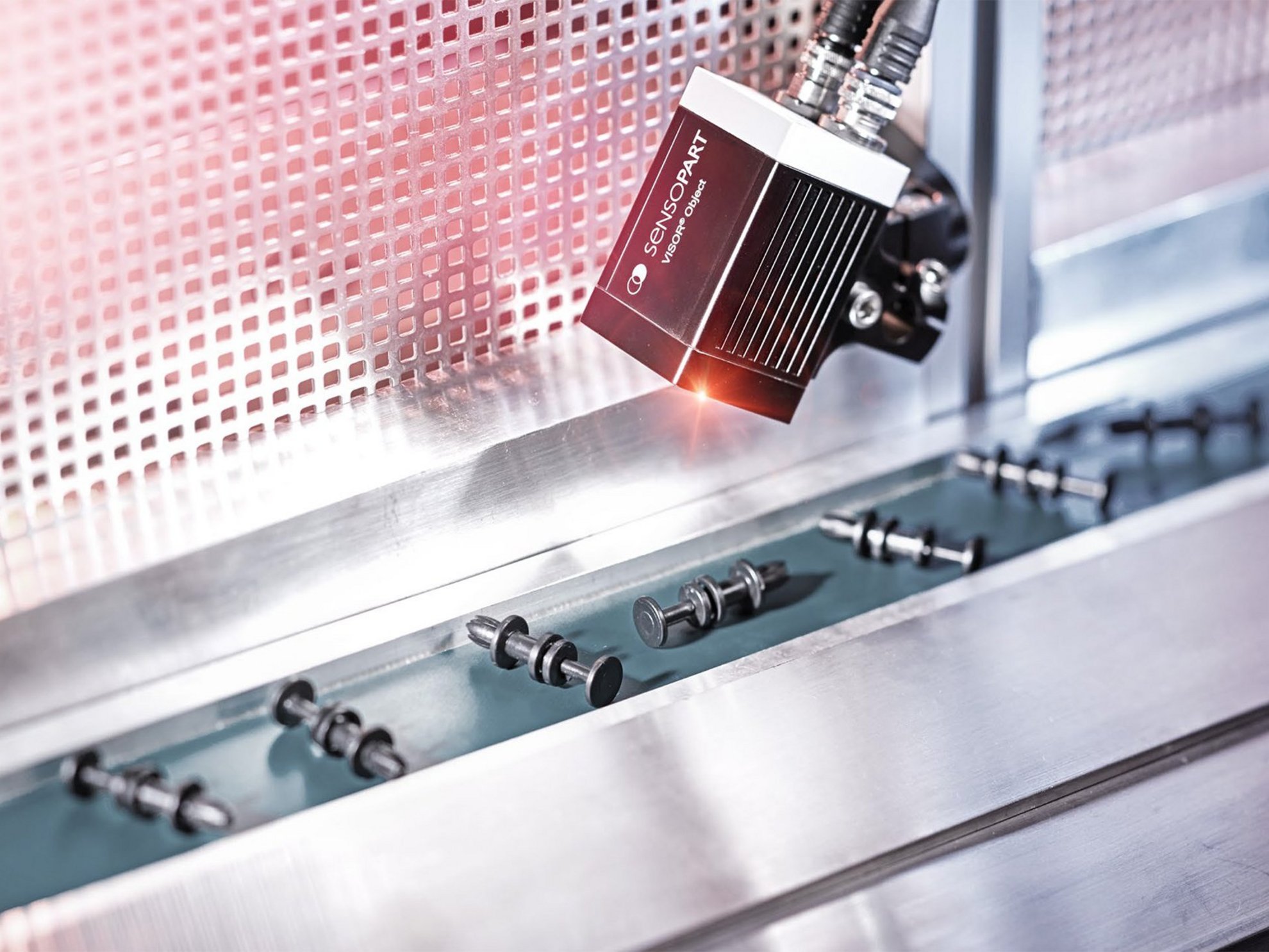
Practical example: Automated quality control through retrofitting
In many existing systems, quality checks are still performed manually, or decision makers rely on random inspections on a sample basis. This makes production susceptible to careless mistakes and slows down the process.
Retrofitting with a compact vision sensor solves this problem directly at the station concerned: The retrofitted sensor captures an image of the relevant component in the course of production. The integrated software evaluates the defined quality characteristics in milliseconds and transmits the result to the control system. This allows defective parts and deviations to be detected immediately in the process. This prevents costly scrap, reduces the workload on staff, and enables thorough and reliable inspection.
Praxisbeispiel: Qualitätskontrolle nachrüsten bei Abraham Automation
Wie effizient sich eine funktionierende Bestandsanlage um moderne Qualitätskontrollen erweitern lässt, zeigt das Praxisbeispiel von Abraham Automation: Statt die vorhandene Anlage zu ersetzen, wurde sie gezielt mit dem Vision-Sensor VISOR® von SensoPart nachgerüstet.
Der VISOR® erfasst die Bauteile direkt im laufenden Fertigungstakt, wertet die definierten Qualitätsmerkmale in Millisekunden aus und meldet das Ergebnis unmittelbar an die bestehende Steuerung. Fehlerhafte Teile werden sofort im Prozess erkannt und ausgeschleust. So konnten wir dazu beitragen, dass aus einer etablierten Bestandsanlage eine effiziente und zukunftssichere Prüfstation wurde – ganz ohne Neuinvestition.
Retrofit-Potenzial Ihrer Maschine prüfen
Sie möchten manuelle Prüfungen automatisieren, Fehler früher erkennen oder eine bestehende Anlage mit moderner Sensor- und Vision-Technologie erweitern? Lassen Sie sich von unseren Experten beraten! Gemeinsam finden wir die Technologie, die zu Ihrer Anwendung, den vorhandenen Schnittstellen und den räumlichen Bedingungen passt.

What does the procedure for a retrofit project look like?
A successful retrofit follows a structured plan:
- Current situation analysis & objective definition: First, the mechanical condition of the machine, the interfaces, and the available installation space are checked. The specific objective is determined based on this (e.g., automated quality control or code reading).
- Feasibility review & concept: Sample parts are used for tests to determine in advance which sensors, optical systems and types of illumination are best. The plan for mounting and interfaces is developed on this basis – including scheduling for planned maintenance windows.
- Mounting & integration: The new components are installed. Since the basic mechanical system usually remains unchanged, the mounting is typically finished quickly. This minimizes the required downtime.
- Setup & commissioning: The new sensors are configured for the inspection tasks directly during the production cycle and tested using actual parts. A brief orientation for the team ensures that operations continue smoothly.
How much does a retrofit cost?
The costs entailed in a retrofit cannot be determined on a flat-rate basis. Retrofitting a single sensor is fundamentally different from modernizing an entire test station or production line.
It's not just the price of the hardware used that matters. Planning, programming, mechanical integration, testing, and commissioning can account for a significant portion of the total.
The three main cost factors
- Expenditure for hardware & components: What components are required (e.g., sensors, cameras, illumination, mounting brackets)?
- Expenditure for integration and adaptation: How much effort is involved in the mechanical mounting, wiring, and integration of the interfaces into the existing control system?
- Expenditure for commissioning & configuration: How complex is the configuration of the sensor technology for the different component variants, and how long do the test runs within the production cycle take?
When will the retrofit pay for itself?
Whether and when a retrofit will pay for itself depends on the investment cost, the remaining useful life, and the specific potential for improvement.
The following can be used as a rough guideline:
- Annual benefit = avoided scrap + reduced rework + saved inspection time + avoided downtime costs
- Payback period = investment costs ÷ annual benefit
Whenever possible, use actual production data from your facility for the calculation (e.g., current defect rates, hourly rates for rework, hourly system downtime costs).