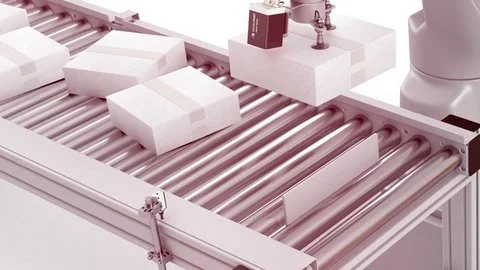
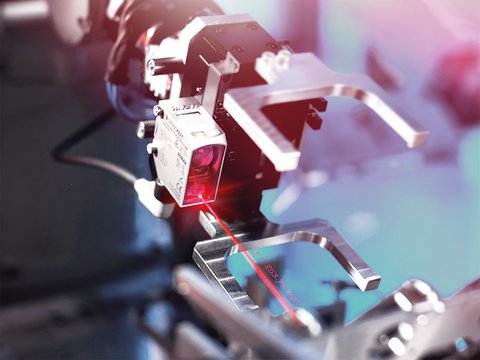
The photoelectric diffuse sensors and light barriers in our DTECT® Presence Series operate using highly developed laser technology and LEDs. Small, precise laser-light spots enable exceptionally accurate small-part detection in automated systems.
Various sensor principles are available for different installation situations and requirements, including photoelectric through-beam sensors, photoelectric retro-reflective sensors, photoelectric diffuse sensors, and sensors with background suppression. We would be pleased to assist you personally as you search for the ideal solution for your application.

Selection guide: Which light barrier sensor do you need?
Photoelectric through-beam sensor, fork sensor, photoelectric retro-reflective sensor, photoelectric diffuse sensor or a sensor with background suppression (BGS) – every option offers its own advantages and properties. The sensor principles differ primarily in terms of range, installation effort, and behavior in relation to the background or object surface. There is a suitable principle of operation for every area of application.
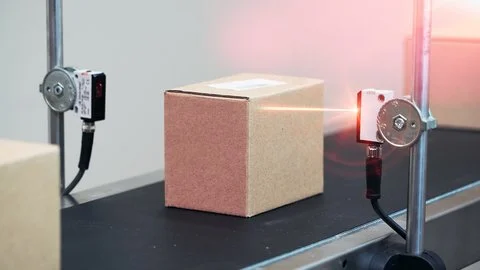
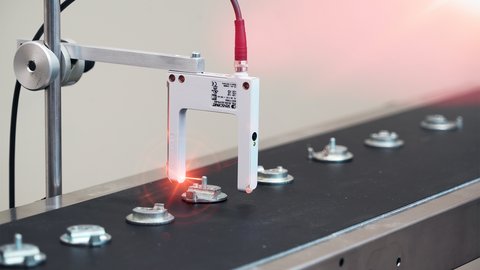
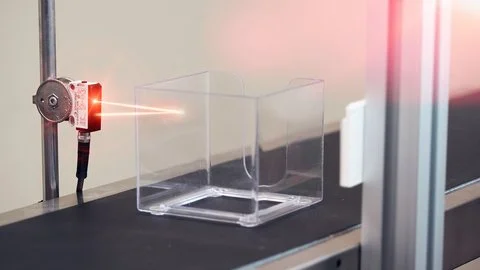
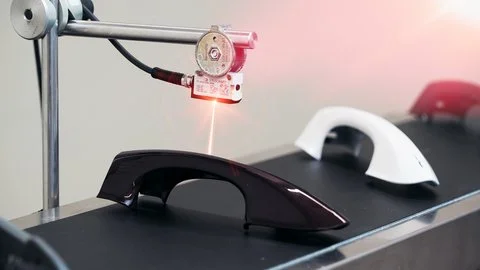

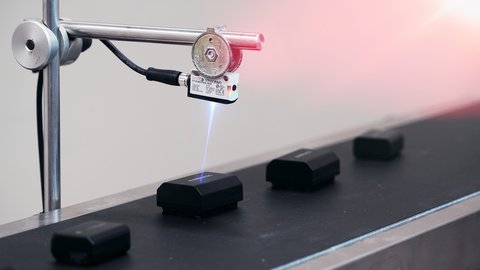
A comparison of four sensor operating principles: Which one is the best choice?
The following overview shows you at a glance which sensor solution is best suited for your application.
Sensor version | Components required | Properties | Advantages as compared to other sensors | Ideal solution for |
Photoelectric through-beam sensor |
|
|
|
|
Photoelectric retro-reflective sensor |
|
|
| |
Photoelectric diffuse sensor |
|
|
|
|
Sensor with background suppression |
|
|
|
|
Fork sensor |
|
|
|
|
The advantages of our DTECT® Presence photoelectric diffuse sensors
- Reliable and precise object detection, with laser or LED
- Flexible adjustment using teach-in, potentiometer, control line or fixed presettings
- IO-Link capable sensors for easy parameter configuration and integration
- Different sizes, ranges and switching variants, for nearly every installation situation
- Reliable object detection even with transparent materials or challenging surfaces

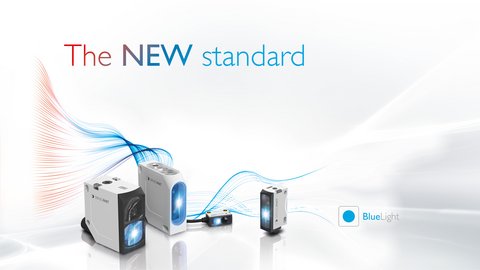
Detect more, do more in industrial automation.
BlueLight technology for optical sensors
The BlueLight technology employs shortwave, high-energy blue light to enable reliable detection of dark, shiny or semi-transparent objects. This approach improves detection stability in automated processes – ideal for applications in which classic red light sensors reach their limits.
IO-Link sensors: For intelligent networking
IO-Link creates a standardized digital interface between sensors, actuators and the control system. This allows faster device configuration, transparent monitoring of states and reliable transmission of process data – for stable processes and efficient, networked production.

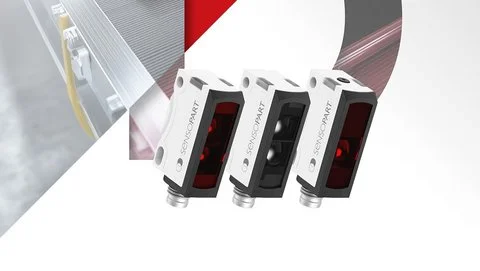
The Power of 3: Three sensors for 99% of your applications
The "Power of 3" puts an end to the time-intensive search for the perfect individual sensor. Whether shiny metal parts, deep black packaging, or transparent PET bottles, with our many years of experience, we have bundled the essence of industrial object detection into three compact sensors that reliably carry out 99% of your tasks.
Interested in our Products?
Our experts are here to help! Reach out using our contact form.
Typical applications for photoelectric diffuse sensors & light barriers
Photoelectric diffuse sensors and light barriers are used in industrial automation wherever reliable object detection is required. They facilitate stable production operations and automated material flows – even with varying object distances or changing ambient conditions.
Depending on the application, utilize the strengths of the various different sensors in the DTECT® Distance Series. Several typical examples and suitable sensor solutions are provided below.