
Ejemplos de aplicación
Los siguientes ejemplos de aplicación le muestran los posibles usos de nuestros productos en la práctica.
Filtrar ejemplos de aplicación
48 Los ejemplos de aplicación coinciden con sus criterios de búsqueda
Automated Manufacturing and Assembly of COVID-19 Test Kits
To streamline the production of COVID-19 test kits, automated assembly of the tests is necessary. The test kits consist of several components. To automate their assembly, the rotation direction as well as the prone/ spine position of the individual parts must be determined. Only then can the kits be correctly assembled by the machine.

Automated Screw Fastening of Electrical Components
In electronics manufacturing, printed circuit boards (PCBs) are often fastened automatically by robots—for example, in control units, battery packs, or other assemblies. To ensure precision and reliability, the robot needs accurate information about the PCB's position and the exact location of each screw hole. A vision sensor handles this task by confirming the PCB is correctly positioned and providing the robot with precise screw point coordinates.

Automated bolting of the upper housing part
The upper part of the housing must be screwed to the lower part of the housing. To do this, the sensor must detect the position of the screw holes in the housing top.

Automated fastening on the conveyor belt
In the production of electronic components, components must be screwed together. Automating this process helps screw as many components as possible in the shortest time without compromising quality. To achieve a short cycle time, screwing operations are performed continuously while components move along the conveyor belt, ensuring a fast and efficient process

Automatic dispensing of lubricant
This process requires millimetre precision so that no spreading or smearing occurs when dispensing lubricants. Lubricant must be accurately applied in sufficient quantity to guarantee proper functioning. If too much lubricant is dispensed, malfunctions will occur.

Check of the correct feeding of screws in the right position
The quantity of screws required for battery pack assembly is stored in a bunker feed system and fed from there to the screwing systems accordingly. For smooth production, it is important that misaligned screws are detected by the sensor and only those in the correct position are fed to the screwing system.

Checking the colour and position of multi-coloured cables
In many applications, connector harnesses with colour-coded pin positions are used to make electrical connections between different components.

Checking the correct position of a connector
During the assembly and production of electronic parts, connectors must be attached to printed circuit boards, and wires or cables are inserted in the connectors. The aim of the application is to check whether a connector has been fully inserted into the socket.

Checking the position of adhesive labels
During final product control, it is to be checked that the products have a uniform appearance. The aim of the application is to guarantee the correct position of adhesive labels on packaging so that the products appear identical on the sales shelf.

Checking the right spring type
Vibration spiral conveyors can be used for sorting, conveying and transporting a wide variety of small parts and connecting elements.
Springs, screws, nuts, pins, washers, caps and special elements are sorted and made available for automatic further processing. Different batches with different springs can be processed in a vibratory bowl feeder. Getting the wrong springs down the line will result in rejects and/or machine damage. A vision sensor is used to ensure that the correct spring type is fed.

Closure check of bottles
During final product control it is checked that the products are correctly sealed. The aim of this application is to check that closures are fully sealed so that products cannot leak during transport.
Coating Inspection with UV Light
In electronics manufacturing, it's essential that circuit boards are properly coated with a protective lacquer to ensure both functionality and long-term durability. To guarantee quality, the presence or absence of this coating must be inspected automatically as part of the production process. A vision sensor is used to verify the coating on electronic components.
Detecting a membrane
In many components in the process industry, a thin membrane ensures pressure equalization and thus reliable operation of the component. If this membrane is missing, malfunctions can result later on.
Consequently, before assembly can be continued, a reliable check is required to ensure the membrane is correctly in place. In addition, the membrane is not always positioned exactly during feeding and deviations of several millimeters in depth can occur. A sensor can be used to perform this presence check.
Detecting flat objects on conveyor belts
Very flat packaging, often in different colors, is transported on conveyor belts. In order for downstream processes such as counting, separating or ejecting to function properly, these objects must be reliably detected. A sensor is to monitor their presence independently of the height and color of the packaging.
Detection and Control of Thermal Paste on Printed Circuit Boards
On many PCBs, thermal paste ensures optimal heat transfer between electronic components and a heat sink. Incorrect application of thermal paste can lead to damage to the components. To prevent this risk, a camera should check the thermal paste for presence, position and correct geometry.

Detection of Wooden Panels for Precision Drill Automation
Furniture production often requires drilling numerous holes in different types of wooden panels. To automate this process, the exact positioning of the wooden panels must be accurately identified.

Detection of foil coils during transport
In the production process for films, the films are transported from one station to the next using roller conveyor belts. Optical sensors are used to verify the presence of the films in order to initiate the next production step.

Detection of plates
One task in industrial automation is the detection of platelets using an optical sensor. The flakes can be metallic and shiny or black and highly light-absorbing.
Detection of printed marks with contrast sensors
In packaging machines, products are packaged using printed foil. To ensure that the foil can be cut exactly to the required size, a sensor must reliably detect the designated printed mark and trigger the cutting process with precision.

Detection of the screws in the feeder
The quantity of screws required for battery pack assembly is stored in a bunker feed system and fed from there to the screwing systems individually. For subsequent control of the correct position of the screws , they must be detected at a specific position in the feed system in order to provide a trigger signal.

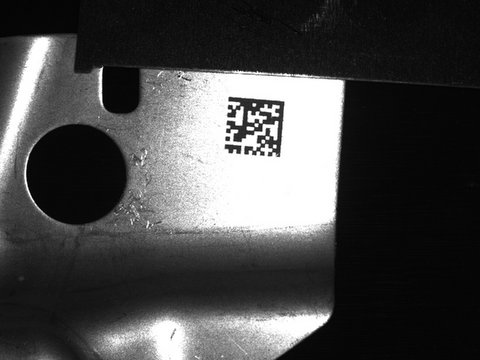
Effortless Traceability: Displaying code contents, texts,
In modern manufacturing, the need for seamless component traceability (Track-and-Trace) continues to grow. Data Matrix Codes (DMCs) have emerged as one of the most reliable methods for identification and traceability. The goal is to scan the Data Matrix Code on each component, guaranteeing precise product processing and flawless serial number management.

Filling quantity monitoring of the screw supply
A large number of screws are processed during the assembly of a battery pack. Bunker feed systems are used to stock these screws. In order to avoid an interruption in production, it is important to be informed in good time that screws need to be replenished.

Handling Door Seals in Automotive Manufacturing
In car door seal production seals of various lengths must be handled with precision. To ensure correct placement, each seal is guided along a conveyor belt. During transport, the end of the seal must be detected so the conveyor can stop at the exact position for the next step. An optical sensor is required to identify the end of the seal in continuous operation and send a signal to the conveyor belt to stop at the correct position. Once the seal is correctly positioned, it can move on to the next production step.

Material feed from a carrier (casing parts)
Components for the production process are supplied in load carriers. The challenge is to position the load carriers as precisely as possible, as this is imperative for a stable, robot-aided handling process.

Measuring a gap between two metal sheets
During assembly, it is frequently necessary to align two metal sheets as close as possible in the joining process in order to guarantee a good weld seam. The aim of the application is to determine the gap between two metal sheets and to transfer the measured value to the control system.

Measuring the radius of a drill hole
Punched, milled or cut holes in metal sheets are checked for dimensional accuracy during assembly.

Monitoring the correct application of lubricant
High precision is of utmost importance during the application of lubricant. However slight irregularities may occasionally occur, which can compromise the production process. It is therefore important to detect potential errors at an early stage.

Placement of electronic components in casing
In electronics manufacturing, processes often require the handling of very delicate or particularly small components. When placing a control chip, as in this example, no gripper errors may occur, as damage must be avoided under all circumstances.

Position control of car body parts
Painting is an important step in automobile production, which not only fulfills aesthetic but also functional aspects. In this step, the body of the vehicle is coated with paint. An important part of the overall process is the position control of the various body parts after drying with the help of an optical sensor. To do this, all car body components such as the bonnet, trunk lid, and doors must be closed in order to move on to the next step, the assembly.

Position detection for automated bolting
The battery modules must be screwed into the lower part of the housing. The screw holes are usually located under mechanical devices, which in turn have an opening. The sensor is to be used to detect the position of the screw holes underneath.

Position of parts in the tray
During the assembly, packaging and production processes in different sectors, parts must be collected from trays for individual work steps.

Precise Storage Space Detection in Automated Warehouse Systems
Automated storage and retrieval systems (AS/RS) are essential to today’s high-efficiency intralogistics operations. They enable fast, organized storage and retrieval while maximizing the use of available space. Goods are stored in containers or bins within compact compartments to streamline logistics and increase throughput.
To ensure smooth and error-free operation, these systems depend on accurate compartment positioning and reliable occupancy monitoring. Without proper detection, collisions and storage errors can occur. That’s why a robust optical sensor is needed to determine whether a compartment is empty, partially filled, or fully occupied, helping maintain a safe and efficient material flow.

Presence Detection in Robotic Grippers
Bauteile sollen mithilfe eines Doppelgreifers aus einer Maschine entnommen werden. Lichttaster sind erforderlich, um die Anwesenheit der Teile zuverlässig an den Roboter zu signalisieren. Bei einem Greifprozess muss überprüft werden, ob das Objekt korrekt gegriffen wurde. Beim Ablegen kann es vorkommen, dass das Objekt am Greifer hängen bleibt und der Roboter beim nächsten Greifprozess einen Crash fährt. Es werden also zwei Schaltpunkte benötigt. Ein Schaltpunkt, um den korrekten Sitz zu prüfen und ein Schaltpunk, um zu prüfen, ob der Greifer leer ist.
Presence and completeness inspection for small parts
In assembly processes, inspections must reliably check whether small parts such as seals, washers or spacer rings are completely present and correctly positioned. Missing or incorrectly positioned parts lead to malfunctions or costly rejects and must therefore be detected at an early stage before the next process step is enabled.

Presence of clips on sheet metal parts
When assembling vehicles, sheet metal parts and / or plastic parts must be connected to one another. These are often assembled with clips which the parts are screwed or plugged together.

Reading dot-peened data matrix codes on sheet metal parts
In production, components, e.g. sheet metal parts, must be identified. During assembly processes, there is a risk of mixing up similar components. The identification of an incorrect part after installation can have costly consequences
Reading of lasered datamatrix codes on sheet metal parts
In production, components must be identified. There is a risk of confusion between similar components during assembly. High costs can be incurred if the wrong component is identified after installation.
Reliable Pin Position Control of Electrical Connectors
Almost every electrical component has plug connections with pins. During production, these pins can be bent or incorrectly positioned due to various influences, such as mechanical stress. This can lead to damage to the component. Therefore, careful inspection of the pins for early detection of possible damage is important.

Reliable Position Control of Rollers in Vibratory Conveyors
For correct downstream assembly, rollers—such as those from roller or storage boxes—must enter the vibratory conveyor in the proper orientation. If a roller is misaligned, a sensor must reliably detect it and trigger an automatic return to the bunker via reverse air blast.

Reliable Presence Detection of Objects on the Conveyor Belt
Millions of objects move along conveyor belts every day, advancing to the next processing step. Before downstream operations can begin, it must first be confirmed that an object is present on the workpiece carrier. A sensor is needed to reliably perform this presence check and keep production lines running smoothly.
Reliably measuring stack heights of sheets, load carriers and components
In production and assembly processes, the correct stacking height of components must be checked reliably. The aim is to ensure that a defined number of sheets, load carriers or components with a known individual height are stacked correctly before the next process step is enabled.

Robot feeder system with a vibrating conveyor
In addition to materials being fed in universal load carriers, high flexibility can be achieved by using a bulk storage bin with a vibrating feeder arrangement. This is particularly suited to transporting small parts, such as mechanical components either plastic or metal.

Robot-assisted refueling of AGVs (with Target Mark 3D)
Utilizing robotic assistance, AGVs can be automatically refueled or recharged. The robot will dock the charging system or fuel port to the AGV, streamlining the process.

Robotic assembly on AGVs (with Target Mark 3D)
A robot is tasked with performing various processing steps on a battery pack, which is transported into the processing cell by an AGV

Screw assembly of components
When screwing the outer casing of the cordless screwdriver together, several parameters must be observed – from the order of the screws to the different tightening torque for the individual screws. The varied positions at which the parts are fed complicates the process step even further.

Transfer to test station
The flexible use of mobile robots is an attractive solution for machine tending processes. Yet this flexibility can cause robot positions to be comparatively imprecise.
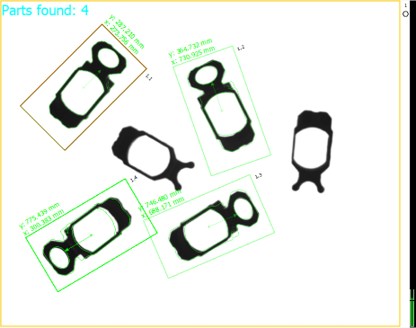
VISOR® Makes Component Positions Visible
A robot is tasked with picking components from a flexible feeding platform. The position of the objects may vary. A vision sensor can identify and relay the exact position of the part to the robot.

Visualisation of entire process with SensoWeb
Throughout the production process, a large quantity of data is generated that has to be monitored and checked. The operator must be able to consult, manage and evaluate this data easily in order to identify and implement any necessary modifications to the process.